De-Influencing the Resume: Why Young Professionals Ditch Buzzwords
Advertisements

Latest developments around De-Influencing the Resume: Why Young Professionals Strip Corporate Buzzwords from Job Applications point to a real preference for clearer professional language, but one widely circulated statistic needs correction.
No reliable source reviewed for this article verifies that exactly 44% of young professionals are removing corporate buzzwords from their resumes in 2026.
What the evidence does support is growing criticism of vague corporate language and stronger emphasis on specific achievements, relevant keywords, and direct communication in U.S. job applications.
The Rise of Authenticity: De-Influencing Resume Buzzwords
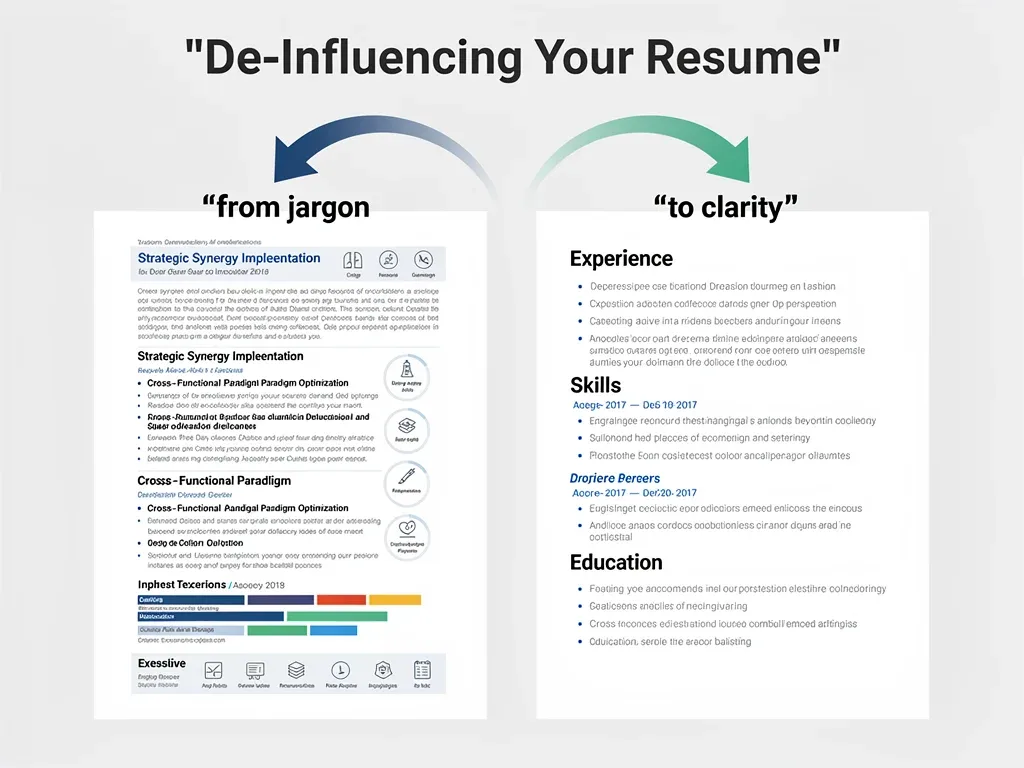
Many job seekers are reconsidering vague phrases such as “results-driven,” “dynamic professional,” or “strategic thought leader” when those descriptions provide little evidence of actual performance.
This does not mean professional language is disappearing; instead, candidates can replace unsupported claims with specific responsibilities, accomplishments, skills, and outcomes.
Recent research on Gen Z workplace language also suggests younger professionals often prefer more direct, literal, and action-focused wording over traditional corporate metaphors.

Why Young Professionals Are Stripping Corporate Buzzwords
Generic language can make several candidates sound similar because terms such as “innovative,” “team player,” and “proven track record” appear repeatedly across professional communication.
A clearer resume gives employers more information about what the candidate actually did, how responsibilities were handled, and what changed as a result.
The useful distinction is therefore not between “corporate” and “authentic” language, but between evidence-based wording and claims that remain too vague to evaluate.
The Impact of Overused Jargon
Corporate terminology becomes less informative when a phrase is used so frequently that it no longer distinguishes one applicant's experience from another's.
Research examining millions of U.S. LinkedIn job advertisements has also documented widespread employer use of terms such as “innovator,” “dynamic,” and “team player.”
Candidates can improve clarity by replacing unsupported adjectives with information about projects, responsibilities, scope, tools, decisions, or measurable outcomes.
Generic claims provide limited evidence of actual ability.
Overused phrases can make candidates sound interchangeable.
Specific examples make professional claims easier to evaluate.
Relevant industry terminology can still be useful when it has a clear meaning.
The Data Behind the Trend: Reassessing the 44% Claim
The claim that 44% of young professionals are actively removing corporate buzzwords could not be traced to a credible 2026 survey with identifiable methodology.
A separate U.S. analysis found that 43% of more than 6.6 million LinkedIn job advertisements contained selected corporate jargon, but that research examined employers.
Another study involving more than 30,000 people ages 18 to 30 documented frustration with particular workplace phrases, supporting dissatisfaction with jargon without proving the 44% resume claim.
Recruiter Reception to De-Influenced Resumes
It would be inaccurate to claim that recruiters universally prefer resumes with every buzzword removed, because hiring practices differ across companies, occupations, and applicant-tracking systems.
Current career guidance instead emphasizes clarity, relevant action verbs, specific accomplishments, and terminology that accurately matches the requirements of the target role.
The strongest approach combines human readability with appropriate keywords rather than treating all professional terminology as undesirable corporate language.
Clear descriptions help employers understand experience quickly.
Specific accomplishments provide stronger evidence than adjectives alone.
Relevant job-description keywords may help with applicant tracking systems.
Unnecessary clichés can be removed without deleting meaningful technical terminology.
Navigating the New Professional Language Landscape
Modern resume writing increasingly favors concise descriptions that explain actions, context, and results instead of relying primarily on broad statements about personality.
Job seekers should still study each vacancy carefully because terminology used in the job description may represent genuine competencies that employers or screening systems seek.
The objective is therefore precision: preserve relevant skills and keywords while removing language that occupies space without adding evidence or useful context.


Strategies for Effective De-Influencing
Begin by identifying statements that could describe almost any candidate, then replace them with details about the work performed and its significance.
When accurate data exists, numbers can clarify scale through revenue, cost savings, growth, volume, deadlines, team size, efficiency, or other relevant measures.
Not every accomplishment needs a percentage, however, and candidates should never invent metrics simply to make a bullet point appear more impressive.
Replace vague claims with concrete examples.
Quantify outcomes when reliable numbers are available.
Use accurate action verbs that describe what you actually did.
Retain relevant keywords from the role and industry.
Beyond Buzzwords: The Push for Genuine Connection
Clearer resume writing can help candidates communicate their professional identity without relying on formulas that make unrelated applicants sound nearly identical.
That does not require making a resume casual or highly personal; professional documents still need to communicate qualifications efficiently for the target employer.
Authenticity is most useful when it means accurate representation of experience rather than an attempt to sound conversational simply for stylistic differentiation.
The Authenticity Advantage in Hiring
A resume supported by concrete examples can give interviewers more useful material for questions about decisions, challenges, responsibilities, and outcomes.
Specificity may also reduce ambiguity by showing what terms such as leadership, collaboration, analysis, or project management meant in the candidate's actual work.
There is not enough evidence to promise that an “authentic” writing style alone produces better cultural fit or hiring outcomes across all organizations.
Specific examples can make professional experience easier to discuss.
Evidence strengthens claims about skills and responsibilities.
Clear wording can reduce ambiguity during screening.
Accuracy remains more important than trying to manufacture a distinctive voice.
The Generational Divide: Old Habits vs. New Norms
Differences in workplace language can exist across age groups, but they should not be reduced to a simple divide in which older workers favor jargon and younger workers reject it.
Research on Gen Z does indicate a preference for more literal and action-focused alternatives to several established corporate expressions.
Professional language also varies according to industry, company culture, geography, seniority, and role, making generational labels only one part of the picture.
Bridging the Communication Gap
Employers can improve hiring communication by writing job descriptions that clearly distinguish essential skills, responsibilities, expectations, and qualifications from promotional corporate language.
Candidates can respond by matching relevant terminology where appropriate while still describing their experience naturally and avoiding unsupported claims.
The shared objective is understandable communication rather than forcing either traditional corporate vocabulary or deliberately informal language onto every workplace.
Employers can make job advertisements more specific and understandable.
Candidates should adapt terminology to the actual role.
Clarity should remain more important than generational stereotypes.
Feedback from recruiters, mentors, or peers can identify unclear wording.
Future of Resumes: Simplicity, Clarity, and Impact
Resume guidance in 2026 increasingly stresses concise communication, role-relevant keywords, strong action verbs, and evidence of accomplishments rather than decorative language.
Applicant tracking systems also mean that simplicity should not be confused with removing legitimate technical skills, job titles, certifications, tools, or industry terminology.
The likely direction is therefore toward more informative resumes, not necessarily shorter vocabularies: every important phrase should contribute meaningful evidence or search relevance.

Tools and Resources for De-Influencing
Resume-review tools can flag repeated words, generic phrases, missing keywords, readability problems, or weak bullet points, but automated feedback should not be accepted uncritically.
Career centers, recruiters, coaches, and trusted peers can help determine whether a resume communicates achievements clearly to someone outside the candidate's immediate workplace.
AI tools can assist with editing, but applicants should verify every generated statement because inaccurate metrics, skills, responsibilities, or achievements can undermine credibility.
Use resume checkers as editing aids rather than final authorities.
Compare the resume with the specific job description.
Request human feedback on clarity and relevance.
Verify every AI-generated claim before submitting an application.
Embracing Authenticity: A New Era for Job Applications
Removing empty buzzwords can improve a resume when the replacement is more precise information about responsibilities, skills, decisions, and measurable outcomes.
The broader shift is better described as a preference for useful professional language rather than a wholesale rejection of corporate terminology by young workers.
Candidates still need relevant keywords, but those keywords become stronger when accompanied by evidence explaining how the skill was actually used.
Key Point | Brief Description |
|---|---|
De-Influencing Trend | Clearer, more direct workplace language is gaining attention, but the specific 44% resume statistic is unverified. |
Motivation for Change | Specific language can communicate skills and achievements more effectively than vague corporate clichés. |
Recruiter Reception | Clear achievements matter, while relevant keywords still remain important for employers and ATS screening. |
Future Resume Focus | Emphasis on concise language, role-relevant keywords, action verbs, and evidence of impact. |
Frequently Asked Questions About Resume De-Influencing
What exactly does "de-influencing the resume" mean? ▼
It is an informal description for removing vague corporate clichés and replacing them with clearer information about responsibilities, skills, and accomplishments. It is not an established formal hiring methodology.
Why are 44% of young professionals adopting this trend? ▼
That specific 44% claim could not be verified from a reliable survey. Evidence does support broader frustration with corporate jargon and a Gen Z preference for more direct workplace language.
What are the benefits of removing buzzwords from a resume? ▼
Removing meaningless phrases can improve clarity and create space for specific accomplishments. Relevant technical terms and job-description keywords should remain when they accurately represent the candidate's experience.
How do recruiters react to de-influenced resumes? ▼
There is no universal recruiter response. Current career guidance generally favors clear, specific accomplishments while also recommending relevant keywords that employers and applicant tracking systems may use.
What should job seekers do instead of using buzzwords? ▼
Use accurate action verbs, concrete examples, relevant skills, and truthful metrics when available. Tailor each resume to the position rather than replacing one set of generic phrases with another.
Impact and Implications
The strongest evidence does not establish that 44% of young professionals are stripping corporate buzzwords from applications, so that statistic should not be presented as fact.
What is well supported is a practical move toward clearer resumes built around accomplishments, evidence, relevant terminology, and language that communicates real responsibilities.
For U.S. job seekers in 2026, the safest strategy is not to eliminate every “buzzword,” but to remove empty ones while preserving keywords that accurately match the role.