4-Day Workweek: Gen Z's Non-Negotiable Demand Explored
Advertisements
The Gen Z 4-day workweek debate reflects a genuine shift in workplace expectations, but surveys do not support claims that 67% consider it non-negotiable.
Research instead shows strong interest in shorter workweeks alongside other priorities such as competitive pay, flexibility, workplace culture and opportunities for professional growth.
Evidence from international trials also suggests reduced working time can improve employee well-being, although results depend heavily on how organizations redesign work.
What Surveys Actually Say About Gen Z
Gen Z employees frequently express interest in flexible working arrangements, but preferences vary considerably depending on how survey questions are framed.
An iHire survey of nearly 1,100 Gen Z respondents found 45% selected a four-day workweek among their preferred workplace benefits.
That finding demonstrates meaningful demand, but it does not mean almost half would automatically reject every employer offering a traditional five-day schedule.
The 67% Claim Appears to Mix Different Surveys
The original article stated that 67% of Gen Z job seekers considered a four-day week a non-negotiable employment requirement.
Reliable evidence supporting that exact statement could not be identified, while other surveys have used 67% for substantially different questions.
For example, an American Psychological Association survey found 67% of employed adults believed four-day workweeks would become normal within their lifetime.
Strong Support Is Not the Same as a Job Requirement
A worker can strongly prefer a four-day week while still accepting a five-day role because of salary, career development or economic circumstances.
This distinction matters when interpreting surveys because questions about preference, feasibility and willingness to reject a job measure different behaviors.
Articles should therefore avoid converting enthusiasm for shorter schedules into a universal employment ultimatum without evidence directly supporting that conclusion.
Gen Z Does Show Strong Interest in Shorter Workweeks
Although the 67% figure is unsupported, several surveys indicate that younger employees are interested in reducing traditional working time.
A 2024 survey of American Gen Z students and professionals later cited in 2026 reporting found 80% believed four-day weeks should become standard.
This provides stronger evidence for a generational preference while still stopping short of saying those respondents would refuse traditional schedules.
Other Generations Also Like the Idea
Interest in shorter workweeks is not uniquely a Gen Z phenomenon, and some surveys have found similarly strong support among older workers.
KPMG reported that 82% of surveyed employees were interested in a compressed four-day schedule consisting of four ten-hour days.
In that study, 55% of Gen Z respondents found the arrangement highly appealing, but Millennials, Gen X and Boomers showed even stronger interest.
A Four-Day Week Can Mean Different Things
The phrase “four-day workweek” can describe fundamentally different arrangements, making it important to identify which model a survey or company actually uses.
A compressed schedule keeps approximately 40 weekly hours but distributes them across four longer days rather than five conventional workdays.
A reduced-hours model decreases total weekly working time, often toward 32 hours, while maintaining full salary and productivity expectations.
Compressed Hours Are Not Reduced Hours
Four ten-hour days provide an additional day away from work but do not actually reduce the employee's total weekly working time.
A true reduced-hours model typically seeks to eliminate unnecessary meetings, streamline processes and maintain output while employees spend less time working.
These approaches can create different effects on fatigue, caregiving, commuting and productivity, so they should not be treated as interchangeable.
What Scientific Research Found
A major peer-reviewed study published in 2025 examined reduced-hours four-day workweek trials involving 2,896 employees across 141 organizations.
The participating workplaces were located in Australia, Canada, Ireland, New Zealand, the United Kingdom and the United States.
Researchers compared changes with 12 control organizations and found improvements in burnout, job satisfaction, mental health and physical health.
The Companies Reorganized Work Before Cutting Hours
The intervention did not simply remove one workday while leaving every existing meeting, process and productivity expectation untouched.
Organizations first redesigned working practices to improve efficiency and collaboration before entering a six-month reduced-hours trial.
This distinction helps explain why successful four-day weeks usually involve operational redesign rather than attempting to compress identical workloads mechanically.
Reduced Fatigue Helped Explain the Results
The researchers found that lower working time was associated with improvements in employee well-being during the experimental period.
Reduced sleep problems, lower fatigue and improved self-reported work ability helped explain part of the relationship between shorter hours and better outcomes.
The evidence supports reduced working time as a potentially effective organizational intervention, although it does not guarantee identical results for every workplace.
Productivity Does Not Automatically Increase
Claims that four-day workweeks always increase productivity go beyond what current research can justify across every employer and industry.
Trials frequently report stable or improved organizational performance, but participating companies often volunteer because they are already interested in changing work practices.
The effects therefore depend on management quality, task design, staffing, technology and whether unnecessary work can realistically be removed.
UK Trials Produced Encouraging Results
In the large UK pilot, 61 organizations reduced working time by approximately 20% for six months without reducing employee pay.
Follow-up research reported improvements in employee well-being, while participating companies generally maintained their operations during the experiment.
Approximately 90% of workers wanted to continue the four-day arrangement after experiencing the trial, indicating strong employee acceptance.
Companies Often Continue After Testing
4 Day Week Global reports that 92% of companies in the major UK trial chose to continue or planned to continue the model.
That figure is significant because employers had an opportunity to observe real operational consequences before deciding whether the arrangement was sustainable.
However, participating organizations are not representative of every employer, so their experiences should not automatically be generalized across the entire economy.
Why Gen Z Values Flexibility
Gen Z entered professional life during a period when remote work, hybrid schedules and digital collaboration became far more visible than before 2020.
That experience expanded expectations around how work can be organized and weakened the assumption that productivity always requires one fixed schedule.
Flexibility therefore appears repeatedly in employment surveys involving younger workers, even when a four-day schedule is not their highest-ranked individual benefit.
Flexibility Can Matter Almost as Much as Pay
The iHire Gen Z survey found 81.3% rated flexible work options as very or extremely important when evaluating employment.
Competitive and fair compensation ranked slightly higher at 82.2%, demonstrating that financial concerns remain central for younger workers.
This evidence contradicts simplistic portrayals suggesting Gen Z consistently values schedule freedom above salary or economic security.
Gen Z Does Not Universally Want Remote Work
The same survey found substantial interest in office-based work, challenging another common assumption about younger employees and workplace preferences.
Later labor-market data also suggested Gen Z candidates became less likely than older groups to prioritize fully remote positions during 2025.
The broader pattern is therefore preference for flexibility and choice rather than a universal demand to remain away from physical workplaces.
Economic Conditions Can Change Job-Seeker Priorities
Workplace preferences are influenced by labor-market conditions and can change when hiring slows or competition for attractive jobs increases.
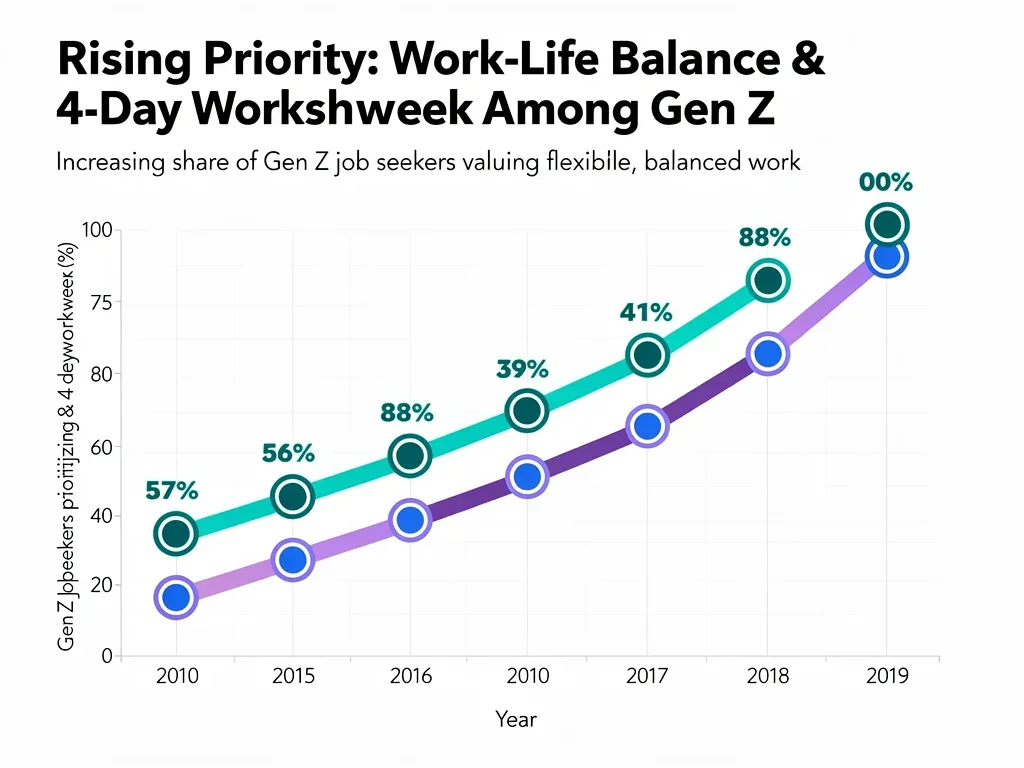
Flexa analyzed more than two million job seekers in early 2025 and found demand for four-day weeks declining across age groups.
By March, approximately 27% of job seekers expressed interest in the benefit, illustrating how quickly preferences can shift with economic conditions.
A Nice-to-Have Can Replace a Non-Negotiable
Flexa described the four-day workweek as increasingly becoming a nice-to-have rather than a top requirement among active job seekers.
That finding directly challenges headlines describing shorter weeks as an irreversible condition that younger candidates refuse to compromise on.
When job opportunities become harder to secure, compensation, stability and career progression can take priority over preferred scheduling arrangements.
Employer Adoption Remains Limited
Worker enthusiasm should not be confused with widespread implementation because five-day schedules remain standard across much of the U.S. economy.
The American Psychological Association reported in 2024 that 22% of surveyed employees said their employer offered some form of four-day workweek.
That was higher than 14% in 2022 and 17% in 2023, showing growth without indicating that shorter weeks had become dominant.
Four Days Cannot Be Implemented the Same Way Everywhere
Software, consulting and other knowledge-work organizations may have greater flexibility to reorganize schedules around output rather than continuous physical coverage.
Healthcare, manufacturing, hospitality and retail often require staffing throughout hours when customers, patients or production systems remain active.
Those employers may need rotating teams or staggered days off instead of closing the organization for the same fifth day.
Workload Compression Is a Real Risk
A shorter schedule can fail when employers remove working hours without also reducing low-value meetings, inefficient processes or unrealistic workloads.
Employees may then attempt to fit five days of obligations into four days, potentially increasing daily intensity and stress.
The successful research trials generally addressed this problem through work redesign rather than treating schedule reduction as a simple calendar change.
Longer Days Can Create Different Problems
A compressed 40-hour schedule commonly involves approximately ten hours of work on each of four days rather than reducing weekly hours.
That model can save commuting time and create an extra day away from work, but long shifts may be difficult for some employees.
Caregiving responsibilities, concentration demands and physical workload can all affect whether compressed hours actually improve work-life balance.
Technology Can Support Shorter Workweeks
Automation and collaboration tools can reduce time spent on repetitive administration, scheduling, documentation and other routine workplace processes.
Gen Z's familiarity with digital tools may make younger employees particularly comfortable experimenting with workflows designed around greater efficiency.
However, technology produces meaningful time savings only when organizations redesign processes rather than filling recovered time with additional low-value tasks.
AI Is Increasing the Debate About Working Time
Generative AI has strengthened discussions about whether productivity gains should translate into more output, fewer employees or reductions in working time.
A 2024 survey cited in later reporting found many Gen Z users believed AI already saved them several hours of work or study each week.
This does not prove a four-day week is inevitable, but it adds another dimension to debates over productivity and the distribution of technological gains.
What Employers Can Learn From Gen Z Preferences
Employers do not necessarily need to adopt a four-day schedule to respond effectively to the concerns reflected in Gen Z employment surveys.
Flexible hours, predictable scheduling, hybrid options, adequate leave and better workload management can address many of the same underlying priorities.
The strongest recruitment strategies identify what employees actually value instead of assuming one headline benefit will appeal equally to every candidate.
Culture and Career Growth Still Matter
A 2024 survey of approximately 400 KPMG interns found workplace culture ranked above a four-day workweek among their employment priorities.
Half viewed flexible work environments as the most appealing workplace trend, while 23% selected a four-day workweek as most attractive.
This demonstrates that young employees evaluate employers across multiple dimensions rather than basing decisions on schedule alone.
Retention May Be as Important as Recruitment
A well-designed shorter workweek can affect existing employees as much as candidates evaluating whether to join an organization.
Reduced burnout and greater satisfaction may strengthen retention when workers believe the schedule genuinely improves their daily working experience.
Companies should therefore evaluate turnover, absence and employee feedback alongside recruitment metrics when assessing a four-day-week experiment.
Employee Feedback Should Continue After Launch
Initial enthusiasm does not guarantee that a schedule remains effective after several months of changing workloads and business conditions.
Regular surveys can identify whether employees feel rested or whether workload compression has gradually replaced the intended benefits.
Organizations can then adjust meeting practices, staffing levels or coverage arrangements before problems undermine the experiment.
Policy Interest Is Growing, but Standards Remain Unchanged
Shorter workweeks have attracted attention from policymakers, labor advocates and researchers in several countries as experiments continue expanding.
That interest should not be interpreted as evidence that the United States has adopted a national four-day full-time standard.
Federal employment rules and ordinary company schedules continue to allow employers and workers to use many different arrangements within applicable labor law.
Company Experiments Are Driving Most Change
Much of the practical evidence currently comes from employers voluntarily testing reduced-hours schedules rather than nationwide legal mandates.
These experiments help researchers compare employee well-being, organizational performance and implementation challenges before broader policies are considered.
The diversity of trial designs also shows why “four-day week” should always be defined clearly when evaluating reported results.
Is the Four-Day Week Becoming the Future of Work?
Interest is clearly substantial, and several international experiments have produced outcomes strong enough for participating employers to continue shorter schedules.
That does not establish that four-day workweeks will replace five-day schedules across every industry or become universal within a specific timeline.
Future adoption will depend on economics, productivity, labor availability, technology and whether companies can redesign work without reducing service quality.
Gen Z Can Influence the Direction Without Dictating It
As Gen Z represents a larger share of employees and future managers, its preferences can influence recruitment practices and organizational culture.
Companies competing for scarce talent may adopt shorter schedules when the benefit strengthens hiring or retention enough to justify operational changes.
But economic conditions and differences between occupations mean generational preferences alone cannot determine how quickly the overall labor market changes.
What the Evidence Really Shows
The evidence supports saying Gen Z has significant interest in shorter workweeks and places substantial importance on flexibility and work-life balance.
It does not support the claim that 67% of Gen Z job seekers universally consider a four-day schedule a non-negotiable condition.
Using accurate language produces a stronger argument because genuine enthusiasm for reduced working time does not require an exaggerated statistic.
The Strongest Findings Are Broader Than Gen Z
Four-day-week trials suggest reduced working hours can improve worker well-being when organizations redesign work and preserve employee compensation.
Employees across several generations also express interest in shorter schedules, making this a broader workplace issue rather than an exclusively Gen Z demand.
The most important trend may therefore be growing scrutiny of how working time is structured rather than one generation imposing a single schedule.
Key Finding | What the Evidence Shows |
|---|---|
67% Claim | No reliable evidence supports 67% of Gen Z treating four-day weeks as non-negotiable. |
Gen Z Interest | Surveys show substantial interest in shorter schedules and broader workplace flexibility. |
Well-Being | Peer-reviewed research found improvements after reduced-hours four-day-week interventions. |
Productivity | Many trials maintained performance, but outcomes vary by organization and implementation. |
Adoption | Employer adoption is growing but remains far from universal in the United States. |
Frequently Asked Questions About Gen Z and the 4-Day Workweek
Do 67% of Gen Z job seekers require a four-day workweek?
No reliable evidence supports that exact claim. Surveys show strong interest, but preference should not be confused with an absolute condition for accepting employment.
How many Gen Z workers actually want a four-day week?
Results depend on the survey. One U.S. Gen Z study found 45% named it a preferred benefit, while another found 80% believed it should become standard.
Does a four-day workweek mean four ten-hour days?
Not always. Some models compress 40 hours into four days, while reduced-hours models cut weekly working time without reducing salary.
Does research show four-day weeks improve mental health?
A 2025 peer-reviewed study involving 2,896 employees found improvements in burnout, job satisfaction, mental health and physical health after reduced-hours trials.
Does productivity always increase?
No. Many trials report maintained or improved performance, but results depend on work redesign, management, staffing, industry and organizational conditions.
Are U.S. companies widely using four-day weeks?
Adoption is growing but remains limited. An APA survey reported 22% of workers saying their employer offered a four-day workweek in 2024.
Is Gen Z the only generation interested in shorter workweeks?
No. Surveys consistently show strong interest across generations, and some studies have found older groups equally or even more interested in compressed schedules.
Conclusion
The Gen Z 4-day workweek trend is real, but evidence supports strong preference and experimentation rather than a universal non-negotiable demand.
Research increasingly shows that properly designed reductions in working time can improve employee well-being while allowing many organizations to maintain performance.
The future will depend less on one unsupported percentage and more on whether employers can translate productivity gains into sustainable, flexible working arrangements.