Gen Z Rejects 9-to-5: The Rise of Fractional Employment
Advertisements
Gen Z fractional employment reflects growing interest in flexible career arrangements, professional autonomy, skill diversification, meaningful work, and alternative income opportunities while introducing important considerations involving financial stability, employment benefits, and career development.
The growing interest in Gen Z fractional employment highlights how younger professionals are exploring alternative career arrangements beyond conventional full-time employment and fixed working schedules.
Flexible working arrangements, digital collaboration tools, and changing professional expectations have created additional opportunities for individuals to develop careers involving multiple organizations and projects.
This guide explores the motivations behind fractional employment, its potential benefits and challenges, and its implications for workers, employers, educational institutions, and the American economy.
The shifting paradigm: Understanding Gen Z's work ethic
Many members of Gen Z are exploring professional arrangements that accommodate personal interests, financial objectives, continuous learning, and individual preferences concerning their working environments.
Rather than evaluating employment exclusively through salary and job titles, some younger workers also consider flexibility, professional development opportunities, organizational culture, and personal well-being.
Interest in Gen Z fractional employment reflects these evolving expectations, although preferences differ significantly between individuals, industries, educational backgrounds, and personal financial circumstances.
Understanding changing professional priorities
Professional priorities can change according to economic circumstances, personal responsibilities, educational opportunities, and the availability of suitable employment within particular industries.
Some younger workers seek greater independence and opportunities to pursue multiple professional interests, while others prioritize predictable income and traditional career advancement.
These different motivations demonstrate why generational employment preferences should not be interpreted as evidence that every young worker rejects conventional employment arrangements.
Defining fractional employment for Gen Z

Fractional employment generally involves providing professional expertise to an organization for a portion of the working week rather than occupying a conventional full-time position.
Workers may maintain ongoing responsibilities across multiple companies, offering specialized services in areas such as marketing, technology, operations, finance, or business development.
Gen Z fractional employment can include different contractual arrangements, with working hours, responsibilities, compensation, and employment protections depending on each professional relationship.
Fractional employment versus traditional freelance work
Freelance professionals often complete individual assignments or deliver specific projects, while fractional professionals may maintain recurring responsibilities within an organization's existing operational structure.
For example, a fractional marketing specialist might coordinate ongoing campaigns for several businesses, whereas a freelancer may be hired to complete one advertising project.
These arrangements can overlap, but distinguishing their characteristics is important when evaluating research about independent work, professional flexibility, and alternative employment models.
What statistics reveal about Gen Z fractional employment
Research concerning younger workers demonstrates interest in flexible employment arrangements, although different studies use different definitions of freelance, independent, temporary, and fractional work.
These methodological differences make it difficult to establish a single percentage representing the proportion of Gen Z workers who have abandoned traditional employment.
Understanding the available evidence provides a more accurate perspective on Gen Z fractional employment than relying on unsupported statistics or generalized descriptions.
What Upwork's research reveals about younger freelancers
Research published by Upwork in May 2024 reported that 52% of surveyed Gen Z professionals had participated in freelancing during the period examined.
The findings indicate considerable interest in independent professional opportunities, but they do not establish that these individuals exclusively relied on freelance income.
Some professionals may combine freelance assignments with conventional employment, education, internships, or other activities instead of completely abandoning traditional career arrangements.
Official US employment statistics
According to the Bureau of Labor Statistics report on contingent and alternative employment arrangements, independent contractors represented 7.4% of total American employment in July 2023.
Among employed individuals aged 16 to 24, approximately 2.2% worked as independent contractors in their principal or only occupation during the same period.
These historical statistics measure a different employment category and population, making direct comparisons with freelance participation surveys inappropriate without additional methodological context.
Why the original 64% claim requires caution
Claims suggesting that 64% of Gen Z workers have rejected traditional employment for fractional positions require supporting research that specifically measures this transition.
Interest in flexible schedules, participation in freelance projects, and exclusively pursuing fractional employment represent different professional behaviors that should not be treated as equivalent.
Reliable discussions of Gen Z fractional employment must distinguish documented workforce participation from employment preferences, hypothetical intentions, and predictions about future career decisions.
Economic drivers and societal influences on Gen Z's choices
Economic conditions influence employment decisions, particularly for younger professionals managing housing expenses, educational costs, student debt, and other responsibilities while developing their careers.
Flexible professional opportunities may provide additional income or alternative career pathways when traditional employment opportunities do not fully address an individual's financial requirements.
However, Gen Z fractional employment also involves potential financial uncertainty, making it important to evaluate both immediate earnings and long-term economic stability.
Managing student debt and living expenses
Workers entering the labor market may face substantial expenses associated with housing, transportation, education, healthcare, and establishing financial independence from their families.
Additional professional assignments can provide opportunities to increase earnings, particularly when workers possess specialized skills that are valuable to multiple organizations.
Nevertheless, income from fractional arrangements may fluctuate, requiring careful budgeting and realistic expectations concerning available projects and consistent client demand.
The influence of the gig economy
The expansion of the gig economy has introduced various opportunities for individuals to earn income outside traditional employment arrangements through digital platforms and direct client relationships.
These opportunities include professional consulting, creative services, technology development, administrative support, and other activities performed through temporary or recurring contractual arrangements.
Gen Z fractional employment shares certain characteristics with gig work, although ongoing organizational responsibilities can distinguish fractional positions from short-term assignments.
The impact of digital platforms and remote work
Digital communication platforms, cloud-based software, and online professional networks allow many workers to collaborate with organizations located outside their immediate geographic regions.
Remote-compatible positions may reduce commuting requirements and provide additional scheduling flexibility, depending on contractual obligations and the nature of the work.
These technologies can support fractional employment, although not every occupation can be performed remotely or organized around flexible professional arrangements.
The pursuit of purpose and work-life integration
Meaningful professional responsibilities and manageable working arrangements can influence career decisions across different generations, including younger individuals entering the American workforce.
For some professionals, fractional positions provide opportunities to select projects that align with personal interests, professional goals, and preferred organizational environments.
Gen Z fractional employment may also offer greater flexibility for balancing professional commitments with personal activities, provided workloads and expectations remain manageable.
Creating a healthier work-life balance
Many workers value arrangements that allow them to manage professional responsibilities alongside family commitments, educational activities, personal interests, and other everyday requirements.
A sustainable work-life balance depends on realistic workloads, clear scheduling expectations, adequate compensation, and sufficient opportunities for rest and personal development.
Fractional employment may help achieve these objectives, but managing several clients simultaneously can also introduce additional scheduling difficulties and professional pressures.
The importance of mental health and well-being
Growing awareness of workplace stress and mental health encourages some younger professionals to evaluate employment opportunities according to their potential impact on personal well-being.
Flexible arrangements may provide greater control over particular aspects of work, although uncertainty, demanding clients, and irregular income can create different challenges.
Gen Z fractional employment should therefore be evaluated according to actual working conditions rather than assuming independent professional arrangements automatically prevent stress or burnout.
Finding meaningful professional opportunities
Fractional positions may allow individuals to participate in different industries, organizational missions, and projects that correspond with their personal interests or professional strengths.
This variety can provide opportunities to explore different responsibilities before committing to a particular specialization or establishing a longer-term career direction.
However, meaningful work can also be found within conventional employment, making professional satisfaction dependent on more than an individual's contractual arrangement.
Benefits of fractional employment for younger professionals
Fractional employment offers several potential advantages for workers who possess marketable skills, maintain reliable professional relationships, and can manage competing responsibilities effectively.
These benefits may include diversified experience, increased autonomy, broader professional networks, and opportunities to explore alternative approaches to career development.
The actual advantages of Gen Z fractional employment depend on individual expertise, contractual conditions, client availability, and the ability to maintain sustainable workloads.
Greater professional autonomy
Some fractional professionals can negotiate their working arrangements, establish project boundaries, and choose which organizations they wish to support through their services.
This independence may provide opportunities to develop professional routines that better reflect individual preferences and existing personal or educational commitments.
Nevertheless, contractual obligations, client expectations, deadlines, and organizational requirements can limit autonomy even when workers are not traditional full-time employees.
Skill diversification and professional development
Working with different organizations can expose professionals to varied operational processes, business challenges, technologies, communication styles, and industry-specific requirements.
These experiences may help individuals develop transferable skills that can support future employment opportunities or strengthen their ability to provide specialized professional services.
Gen Z fractional employment can therefore complement career development when assignments provide meaningful responsibilities, constructive feedback, and appropriate learning opportunities.
Diversifying potential income sources
Working with multiple organizations may reduce dependence on a single source of income when professional agreements provide reliable compensation and manageable responsibilities.
However, diversification does not eliminate financial risk because clients may terminate agreements, reduce budgets, delay payments, or change their staffing requirements unexpectedly.
Maintaining appropriate financial reserves and evaluating the reliability of professional arrangements remain important components of sustainable income diversification.
Financial challenges associated with fractional employment
Alternative employment arrangements can introduce significant financial responsibilities, particularly when individuals operate as independent contractors rather than receiving conventional employee benefits.
Workers may need to manage business expenses, insurance costs, tax obligations, unpaid periods, and other responsibilities traditionally handled through employer-sponsored arrangements.
Understanding these challenges is essential for evaluating whether Gen Z fractional employment provides sufficient financial stability for an individual's circumstances.
Managing irregular monthly income
Fractional professionals may experience changes in monthly earnings when client requirements fluctuate or existing contractual agreements conclude without immediate replacements.
Developing a budget based on conservative income expectations can help workers prepare for slower periods and avoid relying on unusually profitable months.
Maintaining an appropriate emergency fund can provide additional financial flexibility when unexpected expenses arise or temporary reductions in professional income occur.
Understanding taxes and self-employment obligations
American workers classified as independent contractors generally need to report their business income and may be responsible for applicable self-employment and income taxes.
Depending on their financial circumstances, independent workers may also need to make estimated tax payments and maintain documentation of eligible business expenses.
Financial planning for Gen Z fractional employment should include appropriate tax reserves and professional guidance when individual reporting obligations become difficult to determine.
Accounting for healthcare and retirement benefits
Independent contractors generally do not automatically receive the same employer-sponsored healthcare, retirement, paid leave, or other benefits available to eligible traditional employees.
Workers must evaluate the cost of obtaining appropriate insurance coverage and establishing retirement savings arrangements when these benefits are not included in professional contracts.
Comparing total compensation rather than gross earnings alone helps individuals assess whether fractional work provides a financially appropriate alternative to traditional employment.
Practical income examples for fractional professionals
Illustrative financial scenarios can help workers compare potential fractional earnings with conventional salaries while considering additional operational expenses and financial responsibilities.
These examples do not represent guaranteed earnings, average industry compensation, or verified market rates for particular fractional employment opportunities.
They provide a starting point for evaluating how different professional arrangements could influence monthly income within Gen Z fractional employment strategies.
Example of three recurring professional clients
Imagine a fractional marketing professional who receives $1,500 monthly from each of three different organizations for providing recurring specialized services.
Under these hypothetical assumptions, the professional would generate $4,500 in monthly gross revenue before taxes, insurance, software subscriptions, and other applicable business expenses.
If one agreement concludes unexpectedly, monthly gross revenue would fall to $3,000 until another suitable professional arrangement becomes available.
Comparing freelance revenue with a traditional salary
A conventional employee receiving $4,000 monthly may also receive paid vacation, employer-sponsored insurance contributions, retirement benefits, or other forms of compensation.
A fractional professional generating $4,500 monthly might need to finance comparable benefits independently, reducing the amount ultimately available for personal expenses.
This example demonstrates why Gen Z fractional employment decisions should consider net financial outcomes instead of comparing gross revenue with employee salaries alone.
Building a reserve for periods without work
Workers with irregular earnings may benefit from setting aside part of their income to cover business expenses, personal emergencies, and temporary reductions in client activity.
Reserve requirements depend on monthly obligations, contractual stability, available savings, insurance arrangements, and the expected difficulty of replacing lost income.
A realistic financial reserve can support professional independence without requiring workers to accept every available project during periods of reduced demand.
Challenges and opportunities for employers
Fractional staffing can provide organizations with access to specialized expertise without necessarily establishing conventional full-time positions for every professional requirement.
However, employers must consider communication processes, contractual responsibilities, organizational continuity, information security, and applicable employment regulations when developing alternative staffing arrangements.
The growth of interest in Gen Z fractional employment encourages businesses to evaluate where flexible professional structures may complement existing workforce requirements.
Adapting recruitment strategies for Gen Z
Organizations can communicate available working arrangements, professional development opportunities, compensation structures, and role expectations clearly throughout the recruitment process.
When flexibility is appropriate for the position, employers may explain scheduling options and remote collaboration requirements within their recruitment materials.
Transparent communication helps candidates determine whether available opportunities align with their professional objectives, financial requirements, and individual working preferences.
Integrating fractional and full-time professionals
Organizations employing different categories of workers should establish clear responsibilities, communication channels, project ownership arrangements, and procedures for sharing relevant operational information.
Fractional professionals may require access to particular systems and documentation while remaining subject to appropriate confidentiality obligations and security restrictions.
Successful integration depends on effective coordination rather than assuming that external specialists can automatically operate within existing organizational structures.
Accessing specialized professional expertise
Some businesses may require specialized skills only during particular periods or for a limited number of hours each working week.
Fractional arrangements can provide access to experienced professionals in areas such as accounting, marketing, technology, operations, or strategic business development.
Gen Z fractional employment may contribute to this staffing approach as younger professionals develop the expertise necessary to manage increasingly specialized responsibilities.
Industries where fractional employment may be appropriate
Fractional staffing is particularly relevant to certain professional services where responsibilities can be clearly defined, coordinated remotely, or distributed across multiple organizations.
However, suitability depends on the operational requirements of individual businesses, necessary qualifications, regulatory obligations, and the nature of available responsibilities.
Understanding these differences helps workers evaluate realistic opportunities within Gen Z fractional employment instead of assuming every industry supports identical arrangements.
Digital marketing and creative services
Digital marketing professionals may provide recurring services involving advertising management, content development, performance analysis, campaign planning, and other specialized business responsibilities.
Creative professionals may similarly support different organizations through design, branding, copywriting, and audiovisual projects when workloads remain compatible with contractual expectations.
These occupations can support flexible working arrangements, although competition, project deadlines, and changing client requirements may influence income and professional stability.
Technology and software development
Technology specialists may participate in ongoing software development, technical consulting, cybersecurity support, data analysis, or other professional services for different organizations.
Many technology-related responsibilities can be coordinated through digital collaboration platforms, provided security requirements and organizational procedures are appropriately maintained.
Gen Z fractional employment opportunities within technology depend on technical expertise, professional experience, client expectations, and the ability to deliver reliable results.
Business operations and financial services
Organizations may engage fractional professionals to support operational planning, administrative coordination, financial management, reporting, or other recurring business functions.
Some responsibilities require specialized qualifications, professional licenses, or access to sensitive information that must be managed according to applicable legal requirements.
Workers interested in these opportunities should evaluate necessary credentials and professional obligations before offering services beyond their existing expertise.
Navigating the new norm: Advice for Gen Z workers
Developing a sustainable fractional career requires more than identifying available projects, since workers must also manage professional relationships and financial responsibilities.
Building relevant expertise, establishing realistic service offerings, maintaining reliable communication, and understanding contractual obligations can support long-term professional development.
Approaching Gen Z fractional employment strategically may help workers evaluate whether alternative arrangements are appropriate for their current circumstances and future objectives.
Building a strong professional portfolio
A professional portfolio can demonstrate relevant skills, previous projects, technical capabilities, and measurable contributions made throughout an individual's developing career.
Include examples that accurately represent your work while respecting confidentiality agreements and obtaining permission before sharing sensitive client information.
A well-organized portfolio can help potential employers or clients understand your capabilities without relying exclusively on job titles or academic qualifications.
Developing professional networks
Professional relationships can help individuals discover potential opportunities, receive constructive feedback, identify learning resources, and connect with experienced specialists in relevant industries.
Participate in professional communities, industry events, educational programs, and appropriate networking platforms where meaningful professional relationships can develop over time.
Networking can support Gen Z fractional employment by increasing access to opportunities, although it does not guarantee consistent work or immediate financial results.
Negotiating clear professional contracts
Written agreements should establish the expected responsibilities, compensation, payment schedules, availability requirements, confidentiality obligations, and procedures for concluding professional relationships.
Depending on the arrangement, contracts may also address ownership of completed work, additional project requests, reimbursement of expenses, and applicable restrictions.
Review agreements carefully and seek qualified professional assistance when contractual conditions involve significant financial commitments or unfamiliar legal responsibilities.
Managing multiple projects effectively
Professionals working with several organizations should establish realistic schedules that account for meetings, project deadlines, administrative tasks, and necessary periods of rest.
Project management tools and structured communication practices can help individuals track responsibilities and avoid accepting commitments that exceed their available working capacity.
Sustainable Gen Z fractional employment depends on maintaining reliable performance without consistently overextending personal resources or compromising existing contractual obligations.
The impact on traditional industries and education
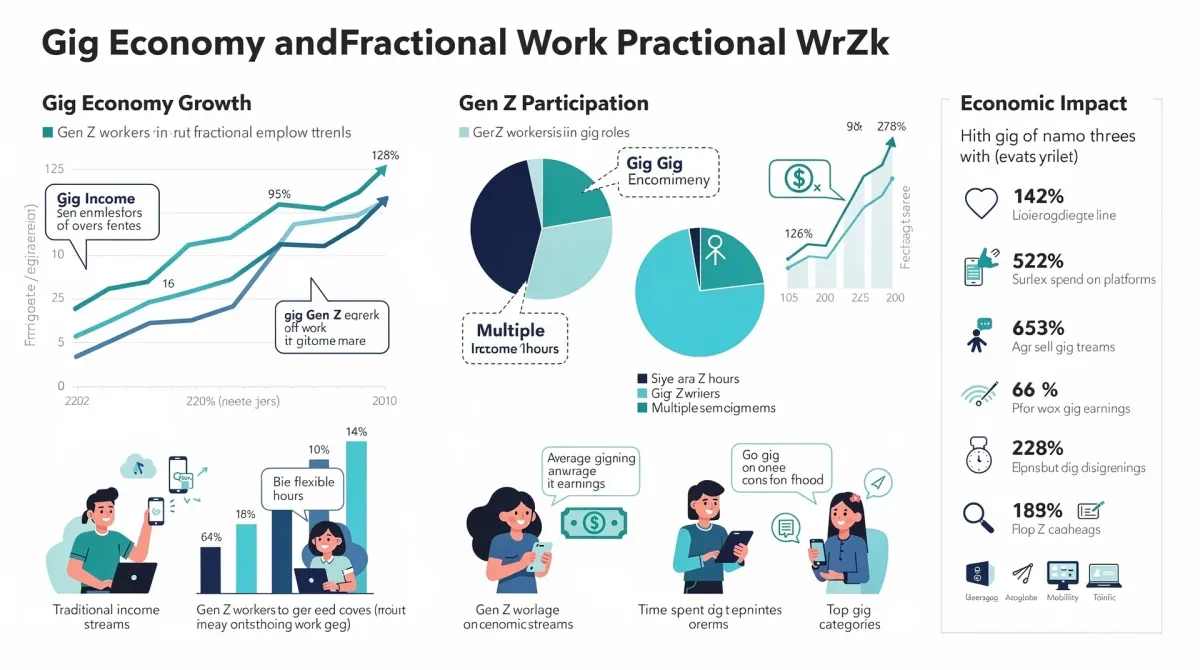
Changing professional preferences and technological developments may encourage organizations to evaluate alternative staffing practices alongside existing conventional employment structures.
Educational institutions can also help prepare students for different career arrangements by providing transferable skills, financial education, and opportunities for practical professional experience.
However, Gen Z fractional employment should be understood as one potential career pathway rather than an inevitable replacement for established professional structures.
Preparing students for different employment arrangements
Universities, vocational schools, and professional training programs can help students develop communication, technical, project management, and problem-solving skills applicable across different industries.
Financial literacy education may also help future workers understand taxes, insurance, retirement savings, professional contracts, and business responsibilities associated with independent work.
These capabilities remain useful whether students eventually pursue fractional employment, entrepreneurship, conventional salaried positions, or a combination of professional arrangements.
The importance of early-career experience
Traditional employment can provide mentorship, structured training, organizational experience, and opportunities to develop expertise before assuming more independent professional responsibilities.
Some fractional positions require established industry knowledge because organizations expect professionals to contribute effectively without extensive introductory training.
Younger workers should consider whether conventional employment experiences could strengthen their long-term prospects before transitioning into specialized fractional arrangements.
Policy implications and the evolving social contract
Alternative working arrangements raise important questions about employment classification, healthcare access, retirement security, income stability, and the distribution of professional responsibilities.
Different contractual relationships may provide different rights and protections under federal and state laws, depending on the circumstances of each arrangement.
Gen Z fractional employment highlights the importance of understanding these distinctions when evaluating alternative career pathways and potential future workforce policies.
Understanding employee and contractor classification
Fractional employment is not itself a distinct universal legal classification under American employment law, and workers may operate under different contractual arrangements.
Whether someone qualifies as an employee or independent contractor depends on applicable legal standards and the actual characteristics of the working relationship.
Simply describing a position as freelance or fractional does not remove an organization's legal responsibilities when the relationship otherwise satisfies employment classification requirements.
The discussion surrounding portable benefits
Portable benefits refer to proposed or existing arrangements designed to help individuals maintain selected protections when transitioning between jobs or professional relationships.
These discussions may involve healthcare access, retirement contributions, paid leave, insurance, and other benefits that can be difficult to maintain through independent work.
Future developments could influence Gen Z fractional employment opportunities, although specific policy proposals should not be interpreted as universally available benefits.
The future of fractional employment in the United States
Technological developments, organizational staffing decisions, economic conditions, and individual professional preferences may influence the future availability of fractional employment opportunities.
Flexible professional arrangements could become more common in suitable industries, while conventional employment may remain important for many essential operational responsibilities.
The future of Gen Z fractional employment will depend on actual labor market developments rather than assuming a predetermined decline in traditional jobs.
The influence of artificial intelligence and automation
Developments involving AI and automation may influence how professionals organize responsibilities, complete administrative tasks, analyze information, and deliver specialized services to different organizations.
These technologies could improve certain operational processes while also changing skill requirements and increasing competition within particular categories of professional work.
Continuous learning remains important because technological developments can create new professional opportunities while reducing demand for other existing services.
Will fractional employment replace traditional jobs?
Traditional employment continues providing important advantages, including predictable compensation, organizational continuity, structured professional development, and access to benefits for eligible workers.
Fractional arrangements may complement these structures when organizations require specialized expertise or workers prefer alternative approaches to managing professional responsibilities.
Rather than assuming one model will replace another, Gen Z fractional employment should be evaluated as part of a diverse and evolving labor market.
Comparison of traditional and fractional employment
Different career arrangements provide distinct financial, professional, and organizational characteristics that workers should evaluate according to their individual circumstances.
Traditional employment may offer greater predictability, while fractional arrangements may provide additional flexibility and opportunities to work across different organizations.
The following table summarizes important considerations when comparing conventional career pathways with opportunities associated with Gen Z fractional employment.
Key Point | Brief Description |
|---|---|
Gen Z's Professional Preferences | Some younger workers prioritize flexibility, meaningful responsibilities, professional development, and alternative career opportunities. |
Freelance Participation | Upwork reported that 52% of surveyed Gen Z professionals participated in freelancing, which does not establish exclusive fractional employment. |
Official Employment Data | In July 2023, 2.2% of employed Americans aged 16 to 24 worked as independent contractors in their main or only job. |
Driving Factors | Potential flexibility, income diversification, autonomy, skill development, and professional exploration. |
Income Stability | Traditional employment may offer predictable salaries, while fractional revenue can fluctuate according to contractual arrangements. |
Professional Autonomy | Fractional workers may negotiate projects and schedules, subject to organizational requirements and contractual obligations. |
Skill Diversification | Working with multiple organizations may expose professionals to different industries, technologies, and operational processes. |
Financial Challenges | Independent workers may need to manage taxes, insurance costs, irregular income, and retirement savings separately. |
Employer Adaptation | Organizations should establish clear responsibilities, compensation arrangements, communication procedures, and appropriate worker classifications. |
Education and Training | Transferable skills, technical expertise, financial literacy, and professional experience can support different career pathways. |
Policy Challenges | Employment classification, healthcare access, retirement protections, and portable benefits remain relevant considerations. |
Future Outlook | Fractional and traditional employment may continue coexisting as organizations and professionals evaluate different working arrangements. |
Frequently Asked Questions About Gen Z and Fractional Employment
Why are some Gen Z workers exploring alternatives to traditional 9-to-5 jobs?
Potential motivations include greater scheduling flexibility, professional autonomy, meaningful responsibilities, skill diversification, and opportunities to manage personal interests alongside professional commitments.
What is fractional employment?
Fractional employment generally involves providing specialized professional services to an organization for only part of a conventional working week. Professionals may maintain recurring responsibilities with multiple companies.
Are 64% of Gen Z workers abandoning traditional employment?
No reliable source was identified confirming that specific percentage for fractional employment. Research about freelance participation or flexible work preferences should not be interpreted as evidence of abandoning traditional jobs.
What percentage of Gen Z professionals participate in freelancing?
Upwork reported in May 2024 that 52% of surveyed Gen Z professionals participated in freelancing. This finding does not establish that these individuals exclusively pursue independent work.
Is fractional employment the same as freelance work?
Not necessarily. Freelancers often complete individual assignments, while fractional professionals may maintain recurring organizational responsibilities. However, these arrangements can overlap depending on contractual conditions.
How does Gen Z fractional employment impact employers?
It may encourage businesses to evaluate flexible staffing arrangements, access specialized expertise, and develop appropriate procedures for integrating professionals with different working relationships.
Are there financial benefits to fractional employment?
Potential benefits include diversified income sources and opportunities to negotiate compensation. However, workers must account for taxes, insurance, business expenses, unpaid periods, and possible income fluctuations.
Can fractional workers earn more than traditional employees?
Potentially, but earnings depend on professional expertise, available clients, contractual compensation, and operating expenses. Higher gross revenue does not necessarily translate into greater personal income.
Do fractional workers receive employee benefits?
It depends on their employment classification and contractual arrangements. Independent contractors generally do not automatically receive the same benefits as eligible traditional employees.
Do fractional professionals need to pay self-employment taxes?
Individuals classified as independent contractors may be responsible for applicable self-employment and income taxes. Tax requirements depend on their financial circumstances and professional arrangements.
Can someone begin a fractional career without professional experience?
Some opportunities may be available to beginners, but many fractional positions require established expertise. Traditional employment, internships, and training can help develop relevant capabilities.
Which industries offer fractional employment opportunities?
Potential areas include digital marketing, technology, design, business operations, financial services, and consulting. Availability depends on professional qualifications and organizational requirements.
Can I combine fractional employment with a full-time job?
Potentially, provided the arrangement complies with applicable employment agreements, confidentiality obligations, conflict-of-interest policies, and realistic workload requirements.
Does fractional employment guarantee better work-life balance?
No. Managing multiple clients, uncertain income, and overlapping deadlines can create substantial pressure. Work-life balance depends on actual working conditions and professional boundaries.
Is Gen Z fractional employment a sustainable career model?
It can be appropriate for some professionals who possess relevant expertise, reliable client relationships, effective financial planning, and manageable workloads. Suitability varies between individuals.
How can workers prepare for a fractional career?
Develop marketable skills, establish a professional portfolio, build relevant networks, understand contractual obligations, and maintain sufficient financial reserves for potential periods of reduced income.
Will fractional employment replace conventional full-time jobs?
There is insufficient evidence to support that conclusion. Different employment arrangements may continue coexisting according to organizational requirements, individual preferences, and broader economic conditions.
What are the long-term societal implications of fractional employment?
Potential considerations include worker classification, retirement security, healthcare access, professional education, organizational staffing practices, and discussions about portable employment benefits.
Conclusion: Understanding the future of Gen Z fractional employment
The growing interest in Gen Z fractional employment reflects changing professional expectations involving flexibility, career development, autonomy, and alternative approaches to earning income.
Although fractional opportunities may offer meaningful advantages, workers must carefully evaluate financial stability, employment protections, professional requirements, and the responsibilities associated with independent work.
By combining realistic expectations, reliable labor market information, continuous learning, and effective financial planning, younger professionals can make informed decisions about their individual career pathways.