Micro-Credentialing Over Degrees: Gen Z's Higher Ed Shift
Advertisements
Micro-credentials and Gen Z are increasingly connected as students look for education that combines academic learning with clearer evidence of job-ready skills.
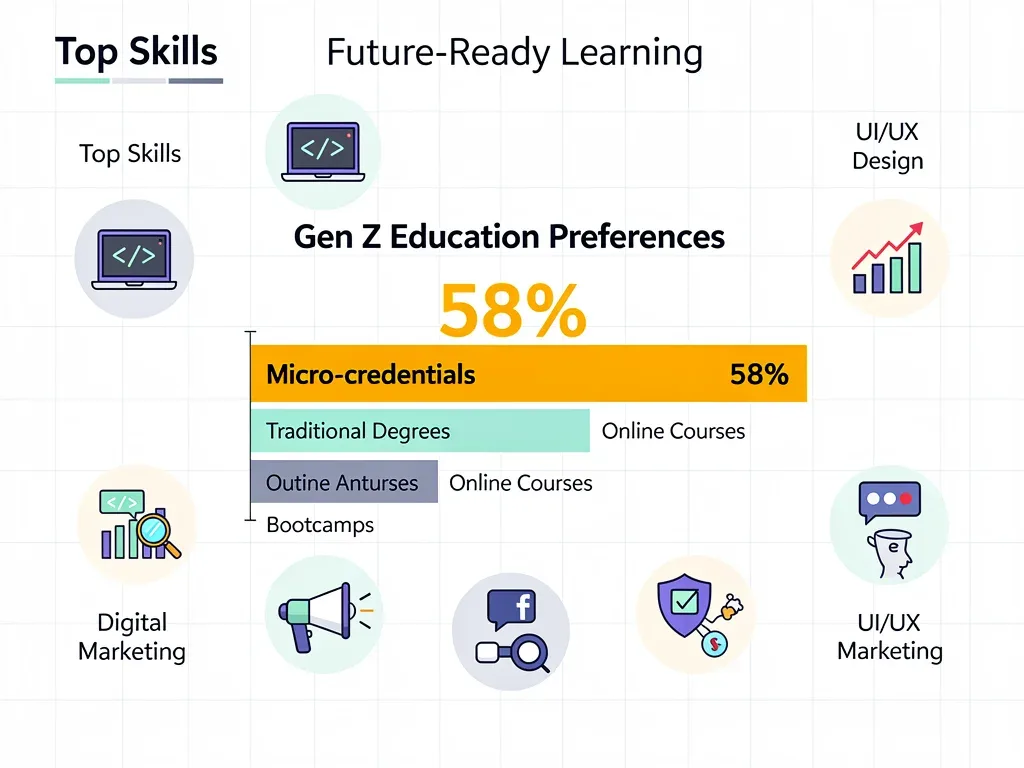
Current research does not support the claim that 58% of Gen Z students are abandoning traditional degrees for micro-credentials in 2026.
Instead, the stronger trend is toward hybrid education, where degrees, certificates, industry credentials and shorter learning pathways increasingly work together.
Micro-Credentials Are Growing, but Degrees Are Not Disappearing
Micro-credentials generally represent shorter learning experiences focused on a specific skill, competency or professional area rather than a complete academic degree.
They may be offered by universities, technology companies, professional organizations or specialized education providers, with quality and recognition varying substantially among programs.
Their growth reflects demand for faster and more targeted learning, but it does not mean conventional higher education has suddenly become irrelevant.
The 58% Claim Is Not Supported by Reliable Evidence
The original article repeatedly states that 58% of Gen Z students will choose micro-credentials over degrees by 2026 without identifying the source behind that statistic.
Current surveys support growing interest in alternative credentials, but they do not establish that 58% of Gen Z has rejected degree education.
A more accurate interpretation is that students increasingly want flexible credentials integrated into broader education and career pathways rather than an either-or choice.
Students Want More Career-Relevant Education
One of the clearest changes in higher education is growing demand for programs that connect coursework directly with employment and practical skill development.
Students increasingly evaluate programs according to cost, flexibility, career outcomes and whether employers can easily understand the skills they have acquired.
This shift fits broader changes in Gen Z workplace expectations, where transparency, development opportunities and meaningful career progression receive significant attention.
Career Readiness Is Becoming Part of the Value Proposition
Universities can no longer assume that students will judge a program primarily by institutional reputation or the degree title printed at graduation.
Internships, applied projects, professional certifications and industry-recognized credentials can provide additional evidence that academic learning connects with actual workplace tasks.
This does not eliminate the broader value of degree education, but it changes what students increasingly expect to receive alongside it.
Alternative Credentials Appeal Because They Are More Flexible
Shorter credentials can be completed faster than a conventional degree and may allow learners to focus on one technology, professional skill or occupational requirement.
That flexibility can be useful for students testing a career direction, employees changing roles or workers trying to update skills without leaving employment.
The format also fits a labor market where particular technical requirements can change faster than a traditional academic curriculum is redesigned.
Flexibility Does Not Automatically Mean Better Value
A short credential is only useful when its learning outcomes, assessments and market recognition justify the time and money required to complete it.
Some programs provide strong occupational value, while others may have limited recognition outside the platform or organization that issued them.
Learners should therefore evaluate provider reputation, assessment quality, employer recognition and transferability rather than choosing a credential solely because it is short.
Cost Is Part of the Appeal
Traditional higher education in the United States can require substantial tuition, living expenses and several years of study before completion.
Some micro-credentials offer a smaller upfront financial commitment, making them attractive to learners who cannot easily pause employment or finance a longer program.
Cost concerns also connect with broader shifts in Gen Z values and priorities surrounding work, education and long-term financial decisions.
Lower Price Does Not Guarantee Higher Return
A $500 credential that employers do not recognize can provide less economic value than a more expensive program with proven employment outcomes.
Students should compare total cost with completion rates, career relevance, credit portability and whether graduates actually use the acquired skills.
Return on investment depends on what the credential enables rather than simply how much less it costs than a four-year degree.
2026 Data Shows Strong Interest in Stackable Credentials
A 2026 national survey conducted for Ellucian found substantial interest among US learners in alternative and stackable credentials.
Seventy-one percent of respondents said they were interested in earning alternative or stackable credentials alongside their degree, while only 3% were currently doing so.
That gap suggests considerable demand, but it also shows that institutional availability, financing and program structure have not fully caught up with student interest.
Financial Aid Could Influence Participation
The same survey found that 84% of students said financial aid availability would influence whether they pursued alternative credentials.
This reinforces the idea that flexible learning still has to fit within the financial realities confronting students and families.
Institutions that add micro-credentials without addressing financing may therefore reach fewer learners than enrollment-interest surveys initially suggest.
Micro-Credentials May Work Best When Embedded in Degrees
One of the strongest trends in current research is not replacement of degrees but integration of industry-aligned credentials within degree programs.
These programs allow students to earn a conventional qualification while also collecting evidence of more specific technical or professional competencies.
This hybrid approach can preserve broad academic learning while improving the visibility of skills that employers want to identify during recruitment.
Students Respond Strongly to Credit-Bearing Credentials
Coursera's 2026 micro-credentials research found that students were substantially more likely to consider programs that incorporated credit-bearing industry credentials.
Seventy-one percent reported they were likely to enroll in programs offering credit-bearing micro-credentials, compared with 35% for programs without them.
That finding supports integration inside higher education rather than the stronger claim that students are abandoning higher education altogether.
Employers Are Using More Skills-Based Hiring
Employers increasingly evaluate applicants through specific skills, work samples, assessments and experience rather than relying exclusively on degree requirements.
Coursera's 2026 survey reported that a large majority of employers use skills-based approaches for entry-level roles and value job-relevant credentials.
This shift helps explain why students want more visible evidence of what they can actually do when they leave an educational program.
Skills-Based Hiring Does Not Mean Degrees Have No Value
Removing a degree requirement from a job description does not automatically mean education, experience and broader academic capabilities become irrelevant.
Employers may still value communication, critical thinking, research ability and foundational knowledge developed through longer educational experiences.
The emerging model is better described as expanding the range of acceptable evidence rather than universally replacing degrees with certificates.

Micro-Credentials Can Make Skills Easier to Identify
A broad degree title may not tell an employer whether a candidate has experience with one particular analytics platform, programming environment or project-management method.
A well-designed micro-credential can make that narrower competency more visible when it includes clear learning outcomes and meaningful assessment.
This is particularly valuable in fast-changing fields where employers need to distinguish between general academic preparation and current technical capability.
Assessment Matters More Than the Badge Alone
A digital badge or certificate has limited value when completing it requires only passive content consumption without demonstrating actual competency.
Project-based assessments, practical assignments and externally validated standards can make a credential more meaningful to employers.
Students should investigate what they must actually demonstrate before assuming that two credentials with similar titles carry comparable value.
Technology Fields Are Natural Early Adopters
Technology occupations frequently involve software, platforms and technical practices that evolve faster than conventional academic program cycles.
Short courses and credentials can help learners update knowledge in data analytics, cloud systems, cybersecurity, artificial intelligence and other rapidly changing areas.
They can also complement the broader computer science, mathematics and analytical foundations taught within longer academic programs.
Project Management and Digital Marketing Also Fit the Model
Micro-credentials are not limited to programming because many professional fields contain specific tools, methods or competencies that can be learned separately.
Project management, digital marketing, business analytics and design are examples where targeted credentials can supplement broader education or professional experience.
The strongest value usually appears when the credential matches a recognized workplace need rather than simply following a popular online topic.
Universities Are Adapting Their Programs
Higher education institutions increasingly offer certificates, badges and shorter credentials either independently or as components within existing academic programs.
This allows universities to respond more quickly to changing skill requirements without redesigning an entire bachelor's or master's degree every time industry needs change.
It also creates more entry points for adult learners who may not initially want to commit to a full academic program.
Stackable Pathways Can Connect Short and Long Programs
A stackable model allows smaller credentials to build toward a certificate, degree or another larger qualification when institutional policies support that progression.
This can reduce the risk that short-term learning becomes isolated from future education by giving learners a pathway to continue advancing academically.
The approach also aligns with evolving Gen Z learning preferences that emphasize flexibility and multiple ways to engage with education.
Recognition Remains One of the Biggest Challenges
The term micro-credential can describe programs issued by universities, technology companies, professional associations and specialized training providers.
Because these organizations use different standards and assessment methods, employers may struggle to determine whether two apparently similar credentials represent equivalent learning.
Without greater transparency, the rapidly expanding market can make it harder rather than easier for students and recruiters to evaluate educational value.
Provider Reputation Still Matters
Credentials associated with established universities, respected industry organizations or major employers may be easier for hiring teams to interpret.
A lesser-known credential can still be valuable, but learners should investigate who recognizes it and what evidence supports its claimed career relevance.
Clear descriptions of learning outcomes, assessment standards and issuing organizations help employers understand what the credential actually represents.
Quality Assurance Is Becoming More Important
As more organizations issue short credentials, policymakers and educators face pressure to establish clearer definitions and quality frameworks.
Without meaningful standards, students may spend money on programs whose content, assessment or labor-market relevance is difficult to verify.
Quality assurance becomes especially important when micro-credentials begin carrying academic credit or contributing toward larger qualifications.
Digital Verification Can Help but Does Not Prove Quality
Digital credentials can make it easier to verify who issued a certificate, when it was earned and what information the credential contains.
Technology can reduce fraud and improve portability, but it cannot determine whether the learning itself was rigorous or valuable.
A securely verified weak credential remains weak, so educational quality and technological verification must be evaluated separately.
Gen Z Still Sees Value in Postsecondary Education
Current research does not support the idea that younger learners broadly believe higher education itself no longer matters.
The 2026 Lumina Foundation and Gallup State of Higher Education research found that 73% of adults without a degree still considered earning a credential as important as it was 20 years ago.
The greater challenge is affordability and access, not a complete rejection of postsecondary learning as a source of career opportunity.
The Question Is Increasingly Which Credential, Not Whether to Learn
Students now have more pathways available, including bachelor's degrees, associate degrees, certificates, apprenticeships, industry certifications and short-term credentials.
This expanding choice can help learners find better-fitting options, but it also increases the complexity of deciding which educational path is trustworthy.
Career guidance therefore becomes more important as the market moves away from one dominant route toward a wider range of credentials.
Nondegree Pathways Can Produce Positive Outcomes
Research into certificates, certifications, licenses and other nondegree pathways shows that many learners value practical preparation and shorter completion times.
A Jobs for the Future and American Student Assistance study found high satisfaction among young people who had pursued defined nondegree pathways.
Those results demonstrate that alternatives can work well for particular learners without proving that every nondegree program outperforms college education.
Learners Need Better Information About Their Options
The same research found that awareness remains a barrier, with many young people saying they would have considered alternative pathways if they had known more about them.
This makes transparent career information important before students commit money and time to either a degree or nondegree program.
Students need comparable information about cost, duration, employment outcomes and credential recognition rather than promotional claims from individual providers.
Micro-Credentials Can Support Lifelong Learning
One of the strongest arguments for shorter credentials is their usefulness after a person has already entered the workforce.
Workers can add new competencies as occupations change instead of returning repeatedly for entirely new multi-year degrees.
This creates a more continuous model of education where learning happens throughout a career rather than ending shortly after initial graduation.
Artificial Intelligence Increases the Need for Updating Skills
AI adoption is changing workflows across technology, business, marketing, finance, creative work and many other professional fields.
Shorter learning experiences can help workers understand emerging tools faster than waiting for entire academic programs to be redesigned.
Longer education still provides broader foundations, while micro-credentials can address specific tools and capabilities that evolve more quickly.
Personalized Learning Has Advantages and Risks
Micro-credentials can allow learners to select combinations that reflect their career goals rather than following one fixed curriculum from beginning to end.
This can create greater autonomy and fits broader discussions about Gen Z's changing definition of success.
However, excessive fragmentation can also leave learners with many disconnected certificates but no coherent progression toward deeper expertise.
Students Still Need a Clear Learning Path
A collection of unrelated credentials does not automatically create the same developmental structure provided by a carefully designed academic program.
Advising can help students determine which foundational knowledge should come first and which specialized credentials make sense later.
The strongest personalized pathways combine flexibility with enough structure to prevent learners from repeatedly choosing short courses without building cumulative capability.
Mental Health and Flexibility Can Influence Educational Choices
Students balancing employment, family responsibilities and academic demands may value programs that allow learning to happen in smaller increments.
Shorter credentials can potentially reduce the commitment required at one time, although they do not automatically make education easier or less stressful.
Flexibility also relates to broader conversations around Gen Z mental health priorities and expectations about sustainable education and work.
Flexible Formats Still Require Student Support
Online and self-paced learning can help students manage schedules, but flexibility can also create challenges with motivation, isolation and completion.
Advising, mentoring, technical support and clear deadlines can remain important even when a program is considerably shorter than a degree.
Institutions should therefore avoid assuming that replacing semester-based courses with online modules automatically solves every access or persistence problem.
Employers Need Better Ways to Read Credentials
The growing number of badges, certificates and professional credentials creates a new challenge for recruiters who must determine which signals deserve attention.
Hiring teams need information about the issuing organization, assessed skills, level of difficulty and relevance to the specific position.
A credential becomes more useful when employers understand exactly what a candidate had to demonstrate to earn it.
Job Descriptions May Become More Skill-Specific
Skills-based hiring encourages employers to define required competencies instead of using a bachelor's degree as a broad screening shortcut.
This can expand access for qualified candidates who developed their abilities through work, certifications, apprenticeships or other educational routes.
It also requires employers to invest more effort in identifying which skills actually predict performance in a particular job.
Universities and Employers Are Likely to Collaborate More
Industry partnerships can help academic institutions understand which technical capabilities are changing quickly and where curriculum updates may be useful.
Employers can contribute practical context, while universities provide academic structure, assessment expertise and broader intellectual foundations.
Well-designed partnerships can therefore produce credentials that have clearer meaning for both students and hiring organizations.
Industry Alignment Should Not Become Narrow Job Training
Universities serve purposes beyond preparing students for one immediate job opening, including developing analytical, communication and research capabilities.
Programs designed entirely around one employer's current tools can become outdated quickly if technology or business practices change.
The strongest partnerships combine durable academic capabilities with specialized learning that can be updated as particular workplace requirements evolve.
Policy Will Influence How Micro-Credentials Develop
Governments and education systems increasingly face questions about financial aid, academic credit, quality assurance and how alternative credentials fit existing qualification frameworks.
Policy decisions can determine whether shorter credentials remain separate commercial products or become integrated more deeply into formal higher education systems.
Public funding also raises questions about which programs demonstrate enough educational and labor-market value to justify taxpayer support.
Transparency Will Be Essential
Students should be able to understand the cost, duration, completion requirements and expected outcomes of a credential before enrolling.
Comparable reporting can reduce the risk that learners choose programs based primarily on marketing language or vague claims about career transformation.
Greater transparency can also help policymakers distinguish high-value credentials from programs that offer little measurable benefit.
The Future Is More Likely Degree Plus Credential
The evidence available in 2026 points toward integration rather than a simple contest between micro-credentials and university degrees.
Students increasingly want programs that provide broad education while also offering concrete proof of skills relevant to jobs and emerging technologies.
This combination allows higher education to retain its deeper academic role while responding to pressure for stronger career relevance.
Different Careers Will Require Different Pathways
Some professions continue to require degrees, regulated qualifications or extensive formal education that cannot realistically be replaced by short courses.
Other occupations may allow candidates to enter through apprenticeships, certifications, portfolios, employer training or combinations of smaller credentials.
The idea of one universal educational pathway is therefore giving way to multiple models suited to different occupations and learners.
What Gen Z's Shift Really Means
The most important change is not that Gen Z has rejected degrees, but that younger learners increasingly expect education to demonstrate clearer value.
Cost, flexibility, career relevance, skills visibility and the ability to continue learning after graduation are becoming more important parts of that calculation.
This broader transformation aligns with discussions about Gen Z's impact on the future of education.
Educational Choice Is Becoming More Modular
A student may begin with a certificate, continue into an associate program, stack credits toward a bachelor's degree and later add industry credentials.
Another learner may earn a degree first and use short programs later to adapt to technological or career changes.
Micro-credentials are significant because they add more building blocks to education, not because they automatically replace every existing pathway.
Micro-Credentials and Gen Z at a Glance
The strongest 2026 evidence supports growing interest in shorter, job-relevant and stackable learning rather than a mass abandonment of college degrees.
Students want more flexibility, employers want clearer evidence of skills and universities increasingly see micro-credentials as a way to connect academic programs with career readiness.
The table below summarizes what current evidence supports and what should not be presented as an established fact.
Separate Evidence From Headlines
Claims about generational behavior can spread quickly when a striking percentage is repeated without explaining who was surveyed or what question was asked.
Reliable reporting should identify the population, sample, methodology and whether respondents were choosing credentials instead of degrees or alongside them.
That distinction is essential when interpreting the rapidly changing relationship between micro-credentials and Gen Z.
Key Point | What Current Evidence Shows |
|---|---|
58% of Gen Z Rejecting Degrees | No reliable source was identified supporting this specific 2026 claim. |
Interest in Alternative Credentials | Strong: 71% of students in a 2026 US survey expressed interest in alternative or stackable credentials alongside degrees. |
Credit-Bearing Credentials | Students show substantially stronger interest when micro-credentials can contribute academic credit. |
Employer Demand | Skills-based hiring and interest in verifiable job-relevant competencies continue to expand. |
Likely Future Model | Degrees, industry credentials and shorter learning pathways increasingly operate together. |
Frequently Asked Questions About Micro-Credentials
Are 58% of Gen Z students choosing micro-credentials instead of degrees?
No reliable evidence was identified for that specific claim. Current research supports strong interest in alternative credentials, particularly when they complement degree programs.
What is a micro-credential?
It is generally a shorter credential documenting learning or demonstrated competency in a more focused area than a complete academic degree.
Are micro-credentials replacing university degrees?
Not broadly. The stronger 2026 trend is integration, with universities increasingly embedding industry and professional credentials into existing academic programs.
Why are students interested in micro-credentials?
Common reasons include shorter completion times, career relevance, flexibility and the ability to demonstrate specific skills to employers.
Do employers value micro-credentials?
Many do, particularly when credentials are industry-aligned, assessed rigorously and clearly connected with skills needed for specific positions.
Are all micro-credentials equally valuable?
No. Value varies according to the provider, assessment quality, employer recognition, learning outcomes and relevance to the learner's intended career.
Can micro-credentials count toward a degree?
Some can. Credit-bearing and stackable credentials may contribute toward larger qualifications when the issuing institution has established an appropriate pathway.
What are stackable credentials?
They are credentials designed so smaller units of learning can build toward larger certificates, qualifications or degrees.
Are micro-credentials cheaper than degrees?
They often require a smaller upfront investment, but cost varies considerably and lower price alone does not guarantee stronger career value.
What should students check before enrolling?
Review the provider, assessments, employer recognition, academic credit, total cost, completion requirements and evidence of relevant career outcomes.
Conclusion
Micro-credentials and Gen Z represent a genuine shift toward flexible, career-connected and skills-focused education, but not a wholesale rejection of university degrees.
Current 2026 evidence instead shows strong interest in credentials that can complement traditional programs, provide academic credit and make job-ready skills easier for employers to identify.
The future of higher education is therefore more likely to combine degrees, certifications and stackable learning than force students to choose only one pathway.